Sign up for free stuff

In the early hours of the night of April 26, 1986, an explosion destroyed reactor number four of the Chernobyl nuclear power plant.
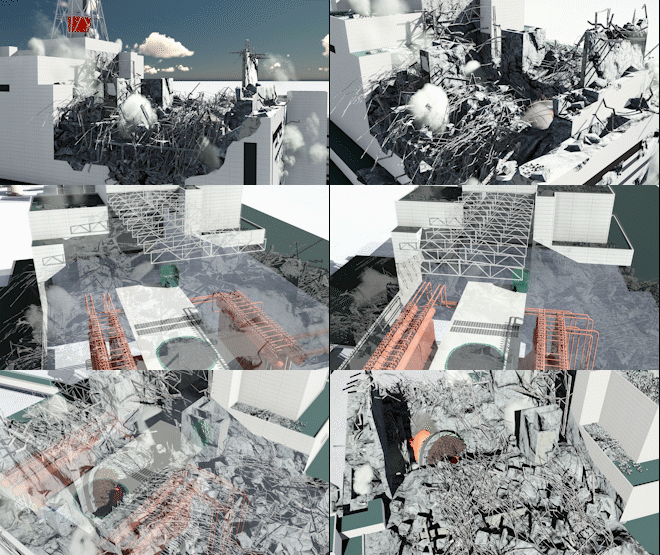
Reactor #4 and Rubble
The fourth unit had been commissioned in 1983 and was being prepared for a maintenance shutdown. A shutdown safety test was scheduled to take place on Friday April 25th 1986, but as the grid was short of power, shutdown was delayed.
The safety test took place on the Friday to Saturday night shift instead. The intention was to prove an experimental power bridge that was designed to maintain cooling water flow in the minutes between a loss of electrical-grid power and the start up of back-up diesel generators. The test involved simulating a interruption of the power supply to the cooling water pumps.
It was later compared to shutting off the engines of an aeroplane in flight to check they could be restarted.
The test did not go well.
The operators lost control of the reactor output and they pushed the emergency SCRAM button to insert boron control rods to kill the nuclear reaction.
However a design flaw meant that initial entry of the graphite tipped rods into the reactor caused the power to surge.
An uncontrolled nuclear chain reaction led to nuclear core meltdown, steam and hydrogen explosions and a fire that spread radioactive contaminants across the the Soviet Union and Western Europe.
An exclusion zone was established and the local inhabitants were evacuated from the worst affected areas which will continue to be contaminated for 200,000 years.
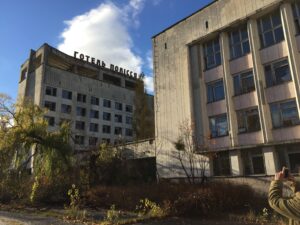
Abandoned hotel in Pripyat
Most of the fuel present before the accident remains in the radioactive core which continues to smoulder.
The 1986 concrete sarcophagus, (constructed in haste and at great risk to workers), began to crumble and in 2016 a new shelter was moved into place. The metal arch of the New Safe Confinement (NSC) measures 105 m high, 257 m wide and 165m long and cost 1.5 Billion Euros. It was built on rails at a safe distance to slide over the top of the existing sarcophagus.
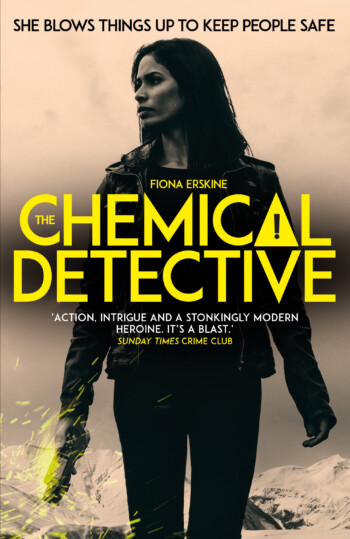
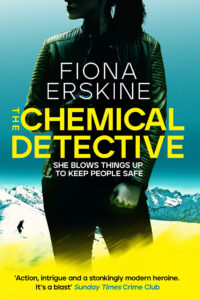
In late October 2018, I visited the site of the accident. My first novel The Chemical Detective had been accepted for publication in Spring 2019 and my editor at Oneworld suggested I visit this key location in my story for publicity purposes.
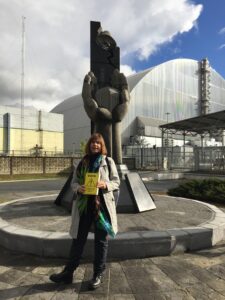
New Safe Confinement, Chernobyl
It was a fascinating visit. The exclusion zone is now an eerily peaceful place; nature has reclaimed the land that humans can no longer inhabit.
What struck me most forcibly as I flew home across the Dnieper wetlands was just how far the airborne radiation spread and how much worse the catastrophe might have been had radioisotopes reached the groundwater. Without the heroic efforts of Soviet engineers, helicopter pilots, miners, construction technicians and liquidators – both conscripts and volunteers, Europe might be a different place today.
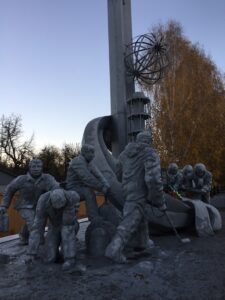
Memorial to the Liquidators
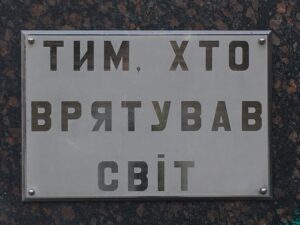
To those who gave their lives to save the world
In 2025, a Russian drone struck the Chernobyl NSC shelter, causing a fire, damaging outer and inner layers and compromising the containment capability.
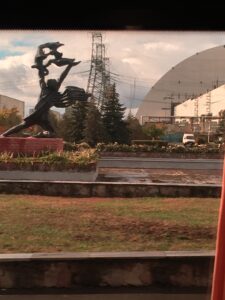
New Safe Confinement 2018 before drone strike
Today there are 440 nuclear power reactors operating in 31 countries and generating about 9% of the world’s electricity. A further 70 nuclear power reactors are in construction in 15 countries, including China, Russia, Pakistan, India, Iran, Turkey and Egypt. Even in peacetime, safe operation of nuclear power plants requires sophisticated levels of control.
Stability matters.
Radiation, like war, doesn’t respect national boundaries.
Fiona, April 2026
Note 1: Chornobyl is the Ukrainian place name (Chernobyl is the Russian version) for a city 90km north of Kviv close to the Ukraine/Belarus border. The placename, in both languages, means mugwort (artemisia vulgaris) or black stem. Construction of the Nuclear Power complex began in 1972 and three reactors continued to operate after the 1986 disaster. The last reactor (number three) was only shut down in December, 2000. In 1986, Chornobyl was still part of the USSR and the Russian version of the placename is used when talking about the nuclear power accident.
Note 2: The RMBK (БРМК: Реактор Большой Мощности Канальный) is high-power channel-type reactor. The four reactors in Chernobyl had a gross power output of 1000 MWe each. The Soviet designed water cooled, graphite moderated reactor is still in use today (Leningrad until 2030, Smolensk until 2035). It has many design flaws, including instability at low power, no secure containment and a positive void coefficient. In the RMBK, water acts as the coolant but the power moderator is solid graphite. Bubbles of steam (voids) form in the boiling water and the cooling capacity falls as the requirement for cooling increases. Modern nuclear reactors have stable power profiles, secure containment and a negative void coefficient. When water is used as both moderator and coolant, excess heat leads to excess steam which leads to a reduction in power and a reduction in heat to be removed, a basic inherent safety feature.
The Chemical Detective is available from all good bookshops and online here.